 Beauty
 Bone Health
 Brain Health
 Energy
 Eye Health
 Gut Health
 Hair
Hair
 Hormonal Health
 Heart Health
 Immunity
 Joints
 Menopause
 Pregnancy
 Kids
Kids
 Sleep
Sleep
 Stress & Mood





Quick Answer: Spirulina and chlorella are freshwater algae with some of the highest nutrient densities of any food on earth. Both are complete protein sources, rich in antioxidants, and well-supported by research for immune function and energy. Chlorella is particularly notable for its detoxification properties and CGF (Chlorella Growth Factor). Taking them together produces complementary benefits: spirulina provides anti-inflammatory and immune support, chlorella adds detoxification and digestive benefits. Together they cover nutritional gaps particularly relevant for plant-based eaters.
The word 'superfood' gets applied to almost everything these days, which makes it easy to dismiss. Spirulina and chlorella are a different category. These are not marketing terms applied to ordinary foods. They are two of the most rigorously studied foods in nutritional science, with decades of peer-reviewed research documenting effects on immune function, antioxidant capacity, heavy metal detoxification, and energy metabolism.
Understanding what each algae actually does, and why combining them makes nutritional sense, takes some explaining. This guide covers the key science in accessible terms, and helps you work out whether these superfoods are worth adding to your routine.
What Are Spirulina and Chlorella?
Spirulina is a blue-green cyanobacterium (technically a prokaryote, not a plant) that grows in warm, alkaline freshwater lakes, primarily in Central America, Africa, and Asia. It has been harvested as food for centuries: Aztec civilisations cultivated it from Lake Texcoco, and it was rediscovered in the 1960s when French researchers found it being consumed by communities around Lake Chad.
Chlorella is a true single-celled green alga, smaller than spirulina and with a hard cell wall that requires cracking before its nutrients become bioavailable. It grows in freshwater environments across temperate regions and is commercially produced in closed bioreactors, primarily in Japan, Taiwan, and Korea, to prevent contamination.
Both are extraordinarily nutrient-dense. By weight, spirulina contains 60-70% complete protein -- more than beef -- alongside significant concentrations of B vitamins, iron, and the antioxidant phycocyanin. Chlorella contains 50-60% protein, and is uniquely rich in chlorophyll and Chlorella Growth Factor (CGF), a complex of amino acids, nucleotides, and peptides found only in chlorella.
Key Benefits: What the Research Shows
Immune support
Both spirulina and chlorella have well-documented immunomodulatory effects. Spirulina's blue-green pigment phycocyanin has been shown in multiple studies to inhibit the inflammatory cascade triggered by histamine-producing mast cells, effectively modulating both the innate and adaptive immune response. Chlorella's beta-glucans and CGF have been found to enhance natural killer cell activity, a key first-line immune defence.
A 2019 study published in Clinical Science found that spirulina supplementation significantly supported immune function, including natural defence mechanisms, after 12 weeks of use.
Antioxidant protection
Spirulina is one of the richest food sources of antioxidants, with phycocyanin, beta-carotene, and vitamin E all present in meaningful quantities. These compounds neutralise free radicals and reduce oxidative stress, which is implicated in ageing, inflammation, and numerous chronic conditions. Chlorella provides complementary antioxidant protection via its high chlorophyll content and carotenoid profile.
Detoxification and heavy metal binding
This is chlorella's most distinctive and well-evidenced benefit. Chlorella's cell wall has a unique structural affinity for heavy metals including mercury, lead, cadmium, and arsenic. Multiple clinical trials have demonstrated that chlorella supplementation can meaningfully reduce the body burden of these metals, supporting natural excretion pathways. A study published in Environmental Health found that pregnant women supplementing with chlorella had significantly lower levels of dioxins in breast milk compared to controls.
Spirulina also has some chelating properties, though these are less pronounced than chlorella's. The combination is particularly relevant for people in urban environments, those who consume large quantities of fish (which can carry mercury), or those who have had significant dental amalgam work.
Complete protein for plant-based diets
Both spirulina and chlorella are considered complete proteins, containing all nine essential amino acids required for protein synthesis. This is unusual for plant-based foods, and makes them particularly valuable for people following vegan or vegetarian diets who may struggle to obtain adequate complete protein from food alone. Spirulina at 60-70% protein by dry weight is among the most protein-dense foods in existence.
Energy and vitality
The iron content of spirulina deserves particular attention. Spirulina provides a plant-based source of iron alongside Vitamin C (which enhances iron absorption) and B12 -- a combination rarely found in a single food. Iron deficiency is the most common nutritional deficiency globally and a leading cause of fatigue, particularly in women of reproductive age and those eating plant-based diets. Supporting iron status via spirulina supplementation can contribute meaningfully to energy levels.
Spirulina vs Chlorella: Key Differences at a Glance
|
Feature |
Spirulina |
Chlorella |
|
Type |
Blue-green cyanobacterium |
Green alga |
|
Protein content |
60-70% by dry weight |
50-60% by dry weight |
|
Standout nutrient |
Phycocyanin (anti-inflammatory antioxidant) |
Chlorella Growth Factor (CGF) |
|
Detoxification |
Moderate chelating properties |
Strong heavy metal binding properties |
|
B12 |
Contains B12 (some question bioavailability) |
Contains B12 and other B vitamins |
|
Best for |
Immune support, antioxidant protection, anti-inflammation |
Detoxification, digestive support, heavy metal binding |
|
Cell wall |
Digestible as consumed |
Requires processing to crack cell wall for bioavailability |
|
Colour |
Blue-green (phycocyanin pigment) |
Bright green (chlorophyll) |
Why Take Them Together?
Spirulina and chlorella have overlapping but distinct mechanisms of action. Where spirulina excels in anti-inflammatory and immune-modulating effects via phycocyanin, chlorella's strength lies in detoxification, digestive support, and the unique biological activity of CGF. The nutritional profiles are also complementary rather than duplicative.
Research has found that taking them in combination may improve insulin sensitivity and help reduce blood glucose more effectively than either alone, an effect attributed to the combined impact of their respective antioxidant and anti-inflammatory compounds. Together, they provide one of the most comprehensive plant-based nutritional foundations available in supplement form.
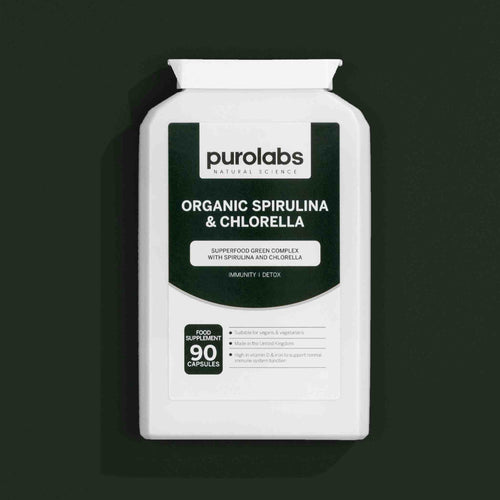
Purolabs Organic Spirulina & Chlorella provides 250mg of each per capsule in a 1:1 ratio, optimised to balance protein, detoxification, and micronutrient content while minimising common side effects like digestive discomfort. It is 100% organic certified, vegan, and free from all synthetic additives.
Spirulina & Chlorella
"Pleased with spirulina and chlorella capsules as my blood pressure has come down. So hoping not to have blood pressure tablets from doctor."
- Linda B., verified Purolabs customer
How to Take Spirulina and Chlorella
Start with a lower dose and gradually increase over 1-2 weeks. Both algae have potent nutritional profiles and some people experience mild digestive adjustment in the first week, particularly chlorella which has significant detoxification activity. Taking capsules with food reduces this risk substantially.
• Standard dose: 1-3 capsules daily with food
• Morning or lunchtime works best -- both can be mildly energising
• Stay well hydrated, particularly when supplementing chlorella, as it supports excretion of bound toxins
• If you have a thyroid condition, note that spirulina provides iodine -- discuss with your GP before supplementing
Spirulina and chlorella are generally very well tolerated. However, as with all supplements containing iodine, those with thyroid conditions should consult their healthcare provider before starting. If you are pregnant or breastfeeding, speak to your midwife or GP first.
Frequently Asked Questions
Can I take spirulina and chlorella every day?
Yes. Both are whole foods used as daily nutritional supplements. Long-term daily use is well-documented in research populations and general consumption. Most people take 1-3 capsules daily with a meal.
Is spirulina a good source of B12 for vegans?
Spirulina does contain B12, but there is scientific debate about whether the form present (pseudovitamin B12) is fully bioavailable in humans. Spirulina should not be relied upon as the sole source of B12 in a vegan diet. A dedicated B12 supplement (methylcobalamin form) is recommended alongside spirulina.
Do spirulina and chlorella taste bad?
The powdered forms have a strong, oceanic flavour that many people find challenging. Purolabs Spirulina & Chlorella is provided in capsule form specifically to avoid this -- there is no taste at all. This is one of the most common reasons people switch from powders to capsules.
How long does it take to see results from spirulina and chlorella?
Energy and vitality improvements are often noticed within 2-4 weeks, particularly if iron status improves. Immune and antioxidant effects accumulate over time. Detoxification effects from chlorella are progressive with continued use.
Are there any supplements that should not be taken with spirulina and chlorella?
Spirulina contains Vitamin K, which may interact with anticoagulant medications such as warfarin. If you are on anticoagulants, discuss with your GP before supplementing. Otherwise, spirulina and chlorella are compatible with the vast majority of common supplements.