
 Beauty
 Bone Health
 Brain Health
 Energy
 Eye Health
 Gut Health
 Hair
Hair
 Hormonal Health
 Heart Health
 Immunity
 Joints
 Menopause
 Pregnancy
 Kids
Kids
 Sleep
Sleep
 Stress & Mood






Quick Answer: For most people in the UK, a high-quality daily multivitamin provides a meaningful nutritional safety net, particularly given the prevalence of low Vitamin D, magnesium, and B12 in the UK population. The key is choosing a formulation with bioavailable nutrient forms, meaningful doses, and no synthetic fillers. A multivitamin is not a substitute for a good diet, but it can reliably address common gaps that diet alone often misses.
The multivitamin is one of the most widely taken supplements in the world, and one of the most debated. Headlines swing between 'multivitamins are essential' and 'multivitamins are a waste of money', usually without much nuance in either direction. The reality, as ever, is more interesting and more useful than extreme.
This article gives you a clear, evidence-informed answer to the question of whether a daily multivitamin is worth taking, and if so, how to choose one that does what it claims.
Why Most People in the UK Are Not as Well-Nourished as They Think
The UK diet has changed dramatically over the past five decades. Ultra-processed foods now account for more than 50% of the average calorie intake in the UK, according to research published in the British Medical Journal. Modern food processing strips out or degrades many micronutrients. Intensive farming has reduced the mineral content of soils, which flows through to the nutrient density of vegetables and grains.
At the same time, several lifestyle factors that were less prevalent in previous generations, working indoors, living at northern latitudes, following plant-based diets, taking certain medications, increase the risk of specific deficiencies. The result is that nutritional deficiencies are far more common in the UK than most people appreciate:
• Vitamin D: Public Health England estimates that around 1 in 5 people in the UK have low Vitamin D levels. The NHS recommends everyone in the UK considers supplementing between October and March.
• Magnesium: Estimated to be inadequate in most UK adults, partly because modern diets are low in wholegrains, nuts, and seeds.
• Vitamin B12: A significant proportion of people over 50 have reduced gastric acid production, impairing B12 absorption. Vegans and vegetarians are also at considerable risk.
• Iron: Deficiency is the most common nutritional deficiency globally and is particularly prevalent in women of reproductive age in the UK.
• Iodine: The UK has one of the highest rates of iodine deficiency in Europe, particularly in women who avoid dairy.
A well-formulated multivitamin cannot resolve clinical deficiencies on its own, those require targeted supplementation at therapeutic doses. But it can consistently address the common, sub-clinical shortfalls that quietly undermine energy, immunity, cognition, and general wellbeing over time.
Who Benefits Most from a Daily Multivitamin?
While most people can benefit to some degree from a well-formulated multivitamin, some groups have particularly strong reasons to include one as a daily habit:
|
Group |
Key Reason |
|
Women aged 18–50 |
Monthly blood loss increases iron requirements; contraceptive pill can deplete B vitamins |
|
Adults over 50 |
Reduced gastric acid production impairs B12 and magnesium absorption |
|
Vegans and vegetarians |
B12 is found almost exclusively in animal products; also, at risk of zinc, iron, omega-3, and calcium gaps |
|
Pregnant or trying to conceive |
Folate and iron requirements increase significantly; a dedicated pregnancy formula is preferable |
|
People with limited sun exposure |
Working indoors or living in the UK means most people cannot produce sufficient Vitamin D |
|
Those with high stress levels |
Stress depletes B vitamins and magnesium at an accelerated rate |
|
People on certain medications |
Some common medications, including PPIs, metformin, and the contraceptive pill, deplete specific nutrients |
The Problem with Most Multivitamins
Not all multivitamins are created equal. Most mass-market options are compromised in one or more of the following ways, which significantly limits their effectiveness:
Poor-quality nutrient forms
The form in which a nutrient is delivered determines how well your body can absorb and use it. Many cheaper multivitamins use nutrient forms chosen for their cost, not their bioavailability. For example, magnesium oxide has an absorption rate of around 4%, compared to the 25% or more achieved by chelated forms like magnesium bisglycinate or citrate. Cyanocobalamin is the cheapest form of B12, but methylcobalamin is significantly better absorbed, particularly in older adults.
Under-dosed ingredients
A product can list 30 ingredients on the label while delivering each at a dose too low to have any physiological effect. This is sometimes described as 'label dressing', the purpose is marketing credibility rather than genuine efficacy. Always check whether the doses listed are a meaningful percentage of the Nutrient Reference Value (NRV), or in the case of ingredients without an NRV, whether the dose aligns with what research studies have used.
Synthetic fillers and additives
Many multivitamins contain excipients that serve manufacturing purposes rather than nutritional ones. Magnesium stearate is used as a flow agent but may interfere with nutrient absorption. Titanium dioxide was used as a whitening agent and has been banned as a food additive (E171) by the European Food Safety Authority due to genotoxicity concerns, though it still appears in some supplements. Maltodextrin is a high-glycaemic bulking agent with no nutritional value. These ingredients are not dangerous in normal supplement quantities, but there is no reason to include them in a formula designed for daily health.
What to Look for in a High-Quality Multivitamin
When evaluating a multivitamin, the label tells you almost everything you need to know if you know how to read it. Here is what to prioritise:
• Bioavailable nutrient forms: look for methylcobalamin (not cyanocobalamin) for B12, magnesium citrate or bisglycinate (not oxide), and zinc citrate or bisglycinate (not sulphate or oxide)
• Meaningful doses: the supplement should contribute meaningfully to your daily requirements, 100% NRV or more for most vitamins, with acknowledged exceptions for calcium and magnesium where capsule size limits what is achievable
• Inclusion of overlooked nutrients: a genuinely comprehensive formula should include Vitamin K2 alongside D3, iodine, selenium, chromium, and ideally CoQ10 and lutein
• No magnesium stearate, titanium dioxide, maltodextrin, or silicon dioxide: these indicate a manufacturer prioritising cost over quality
• UK-made to GMP standards: Good Manufacturing Practice certification means the product has been produced under verified quality controls
• A money-back guarantee: a brand confident in the efficacy of its product should offer one
How Purolabs Multivitamin Compares
Purolabs Vegan Multivitamin was formulated to address the shortcomings common in the market: 34 nutrients in their most bioavailable forms, at doses that make a genuine contribution to your daily requirements. It includes ingredients frequently absent from other multivitamins, Co-Enzyme Q10 for cellular energy production, lutein for eye health, and a full spectrum of B vitamins in active, readily absorbed forms.
The formula contains no magnesium stearate, titanium dioxide, silicon dioxide, maltodextrin, or artificial additives. The capsule shell is plant-based (HPMC), and the product is made in the UK to GMP and ISO 22000 certified standards. Each bottle provides a 60-day supply at one capsule per day, making it genuinely convenient to maintain as a daily habit.
"I've been taking them to improve my skin and keep my hair healthy. The best thing about them is that they are vegan. Purolabs Multivitamins are the easiest way for me to make sure I'm getting all the nutrients I need."
– Natasha, verified Purolabs customer
"I have been using this product for the past 6 months. I am a 76-year-old man who is physically active as a cyclist and found that I have more energy all day, even after a 50-mile cycle ride."
– Stanley R., verified Purolabs customer
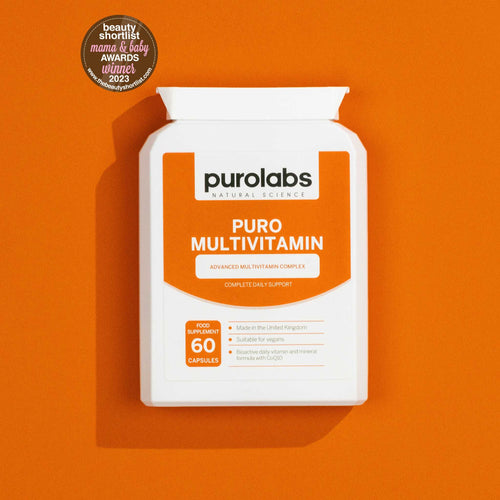
Multivitamin
Glamour named it the best vegan multivitamin, and Vogue described it as 'free from all synthetic additives including the fillers, artificial flavours and bulking agents commonly used in supplements'. The Evening Standard recommended it as best for on-the-go, noting that its signature flat packaging makes it easy to keep in hand luggage without compromising your supplement routine while travelling.
Can a Multivitamin Replace a Good Diet?
No. This point is worth being direct about. A multivitamin provides micronutrients (vitamins and minerals) but it cannot replicate the fibre, phytonutrients, antioxidants, protein, healthy fats, and complex carbohydrates that whole foods provide. The research on multivitamins consistently shows benefits as a complement to a reasonable diet, not as a substitute for one.
Think of a high-quality multivitamin as nutritional insurance. It does not replace your diet, but it reliably covers the gaps that modern life tends to create in even a reasonably healthy one.
Frequently Asked Questions
Is it worth taking a multivitamin every day?
For most people in the UK, yes. Given the prevalence of sub-clinical deficiencies in Vitamin D, magnesium, B12, and iodine in the UK population, a well-formulated daily multivitamin provides reliable nutritional support that diet alone often cannot guarantee. The key is choosing a product with bioavailable nutrient forms and meaningful doses.
Can you take too many vitamins?
With a standard daily multivitamin taken as directed, toxicity is very unlikely. Fat-soluble vitamins (A, D, E, K) can accumulate in the body at very high doses over time, but the doses in a balanced multivitamin are designed to be well within safe limits. Water-soluble vitamins (B and C) are excreted by the kidneys if taken in excess. Always follow the recommended dose and consult a GP if you are taking multiple supplements.
When is the best time to take a multivitamin?
Most multivitamins are best taken with food. Fat-soluble vitamins (A, D, E, K) require dietary fat for absorption, and taking your multivitamin with a meal that contains some healthy fat improves absorption of these nutrients. Avoid taking it late at night, as B vitamins can have an energising effect.
Do multivitamins help with energy?
Yes, if low energy is being driven by nutrient deficiencies, which is common. B vitamins contribute to normal energy-yielding metabolism and the reduction of tiredness and fatigue. Magnesium is involved in energy production at the cellular level. Iron deficiency is one of the most common causes of fatigue in women. A comprehensive multivitamin addresses all of these.
Are vegan multivitamins as effective as standard ones?
A well-formulated vegan multivitamin is equally effective, provided it uses bioavailable nutrient forms. Vegan formulas avoid animal-derived nutrients like gelatin capsules and lanolin-derived Vitamin D3, using plant-based alternatives instead. The Purolabs Vegan Multivitamin uses vegan D3, methylcobalamin B12, and a full spectrum of plant-sourced nutrients in a HPMC capsule.
How do I know if my multivitamin is working?
Some benefits are felt within weeks, such as improved energy, better sleep, and reduced fatigue. Skin, hair, and nail changes typically take 8 to 12 weeks. The subtler effects on immune function, bone density, and long-term metabolic health are harder to feel directly but no less real. If you want confirmation, a blood test via your GP can establish baseline levels for key nutrients before and after supplementation.