
 Beauty
 Bone Health
 Brain Health
 Energy
 Eye Health
 Gut Health
 Hair
Hair
 Hormonal Health
 Heart Health
 Immunity
 Joints
 Menopause
 Pregnancy
 Kids
Kids
 Sleep
Sleep
 Stress & Mood









Joint health is crucial to overall health and longevity. Our musculoskeletal system requires adequate support to not only help us reach new physical heights, but to support daily living such as walking, bending and stretching.
Two natural compounds, chondroitin and glucosamine, have been studied for their beneficial roles in joint health. These two ingredients have been researched in oral supplemental form over the last several decades.
The first large scale study on the synergistic effect of chondroitin and glucosamine was carried out in the early 2000s, with further studies highlighting the varying effects on structural health.
If you are considering supplementing for long term mobility and joint support, then read on to find out the benefits, clinical research and whether chondroitin and glucosamine could be an excellent addition to your daily supplemental toolkit.
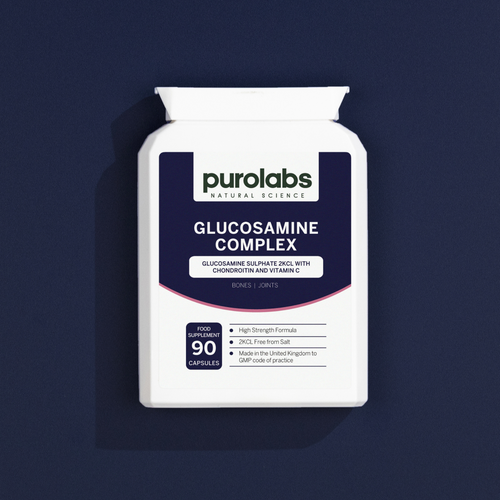
Glucosamine Complex
What is Chondroitin and Glucosamine?
Chondroitin, also known as chondroitin sulfate is a naturally occurring compound already found in the human body. You will find it stored away in cartilage. It is a form of glycosaminoglycan (GAG), helping cartilage to bend and respond appropriately to absorb physical shock from daily movement1.
Many of us see our musculoskeletal system as a carefully built structure of bones, muscles, tendons and ligaments. Cartilage is another component that helps to maintain the structure of the human body, keeping it able to move freely and support the body2. You will find cartilage throughout the body, in joints, the rib cage, ears, nose and airways.
Glucosamine is another compound (an amino sugar) found in the body that helps to support cartilage’s role in keeping the body moving. It is the connective tissue that cushions joints and helps to build and repair cartilage3.
Benefits of Chondroitin
Chondroitin’s benefits primarily focus on cartilage health, and anti-inflammatory benefits4:
- It helps to keep cartilage elastic and hydrated, reducing cartilage breakdown through wear and tear. It has even been shown to inhibit enzymes that break down cartilage
- Aids in joint structure
- Has been shown to increase range of motion and functionality in stiff and inflamed joints
- May reduce inflammation in joint tissues and reduce swelling and pain associated with osteoarthritis
Benefits of Glucosamine
- Building blocks for glycosaminoglycans, required for healthy strong cartilage
- May potentially slow down cartilage degradation over time
- Has been shown to reduce pain, particularly in knee osteoarthritis
- May increase range of motion and reduce joint stiffness
- Lower joint inflammation
- Improve the longevity of the musculoskeletal system, particularly as we age
- Well tolerated, usually regarded as a safer alternative to NSAIDs (if you are currently taking NSAIDs do not stop taking without the guidance of your doctor).
Why take Chondroitin & Glucosamine Together?
Both are taken together because of their synergistic effect5. Glucosamine is a key ingredient to help build and keep cartilage strong and supple.
A combined supplement containing both ingredients helps to nourish and build healthy cartilage. This helps to support wear and tear, whilst delaying the naturally progressive breakdown that occurs as we age.
Chondroitin, Glucosamine & Osteoarthritis
So, what do the studies say on one of the most popular conditions associated with this supplement?
The first studies carried out on the potential health benefits of chondroitin and glucosamine reach back as far as the 1980s, with studies focusing on their role as potential therapeutic options for osteoarthritis.
However, they were being studied separately before their synergistic effects were finally highlighted and researched. Glucosamine was being researched as a remedy for pain reduction and joint health as far back as the 1970s, whilst clinical trials on chondroitin sulfate started to emerge later, in the mid-1980s in France and Italy.
The first large scale study to be carried out on the effects of chondroitin and glucosamine as a combined supplement for structural health and longevity was the GAIT study6.
The GAIT (Glucosamine/Chondroitin Arthritis Intervention Trial) study is one of the most well-known large-scale clinical trial, assessing their effects on arthritis.
1,500mg of glucosamine hydrochloride and 1,200mg chondroitin sulfate daily was administered in the control group. The study found that the supplement may be more beneficial for patients with severe osteoarthritis pain than in those with mild symptoms. It also found that the supplement had less gastrointestinal side effects than conventional treatment for the condition; NSAIDs.
A very large study of 43 randomised controlled trials on almost 5,000 participants with osteoarthritis found pain reduction across the short term (less than 6 months) for those who took chondroitin and glucosamine, compared to the placebo group7.
A 2023 meta-analysis found that the groups who took the combination supplement saw an increased improvement in stiffness and soreness compared to the groups who didn’t8.
Another study on 605 participants aged between 45-75 years, were given chondroitin sulfate (800mg) and glucosamine sulfate (1,500mg). The results found that the group taking the combined supplement showed reduced joint space narrowing in joint space narrowing by the end of the study9.
A meta-analysis of 8 randomised controlled trials focused on glucosamine and chondroitin supplementation for knee osteoarthritis10.
Pain outcome was measured using the WOMAC score, a validated questionnaire used to measure osteoarthritic severity, especially in the hip and knee. It analysed three main areas; pain, stiffness and functionality during daily activities. The higher the score, the worse the symptoms.
Compared to the placebo group, those who took chondroitin and glucosamine saw a significant improvement in WOMAC scores.
Interestingly, the publishers have retracted the study due to insufficient evidence demonstrating that conflicts of interest did not influence the study outcome. While the results appear promising, this retraction means we cannot rely on this single study alone to assess the effectiveness of both compounds for knee osteoarthritis.
The findings are promising. However, more studies needing to be carried out to be able to recommend it as a replacement for conventional therapies for the condition.
Dosage
The clinical data shows that a 1,500mg dose per day of glucosamine, split into 3 x 500mg doses and 800-1,200mg per day of chondroitin, split into three doses is typically effective.
Average results from consistent daily supplementation took between 2-4 months.
The studies also confirmed that both molecules showed better outcomes when taken together.
Interactions
Whilst chondroitin and glucosamine are considered generally safe and well tolerated long term, both can increase the risk of bleeding when taken with common blood thinners like warfarin. If you are taking any blood thinning medication, proceed with caution.
Although the evidence is mixed, those on insulin or medications that reduce blood glucose should monitor levels closely.
It is also important to note that many glucosamine supplements are derived from shellfish, which may trigger an allergic reaction in susceptible individuals.
If you’re unsure about whether it’s for you, always speak to a licensed healthcare professional before taking chondroitin and glucosamine.